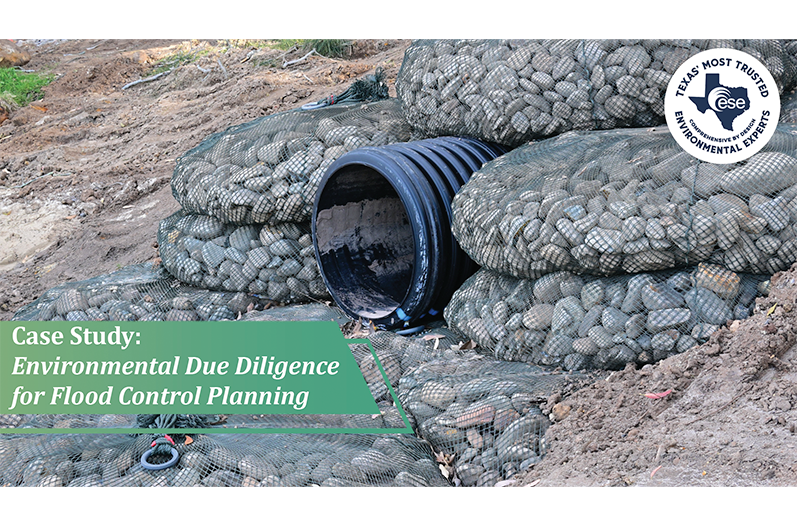
In many projects across Texas, environmental risk is often evaluated based on what can be seen at the surface, yet some of the most important factors influencing a project’s success are not immediately visible.
This was the case for a 17-acre tract being considered for flood control planning, where the property had remained largely undeveloped for decades and did not present any obvious environmental concerns during initial review. While this type of site can appear straightforward, relying on surface-level observations alone can introduce risk if underlying conditions are not fully understood.
Even properties with limited development history can include activities such as storage, equipment use, or maintenance operations that create environmental considerations capable of affecting acquisition, planning, and long-term project performance. Without a structured evaluation, these factors can remain unknown until later stages, where they are more difficult and costly to address.
To support informed decision-making, a Phase I Environmental Site Assessment was conducted in accordance with ASTM E1527-21, incorporating site reconnaissance, historical research, regulatory database review, and agency coordination to evaluate potential environmental liabilities associated with the property.
The results provided a clear and defensible outcome, confirming that no recognized environmental conditions were identified, the property was not included in environmental databases, and vapor encroachment was not expected to impact the site. Minor observations were determined to be non-material and did not affect the overall environmental profile of the property.
This level of clarity allowed stakeholders to proceed with confidence, reduced uncertainty early in the project lifecycle, and established a strong environmental baseline to support future planning and coordination efforts.
Environmental due diligence is often approached as a procedural step, but when it is integrated early in a project, it becomes a strategic advantage that helps protect timelines, manage risk, and support more efficient project delivery.
In a fast-moving environment like Texas, where infrastructure and land development continue to expand, having that clarity early can make a meaningful difference in how successfully a project moves forward.
Go Here to read the full Case Study.