Cultural Resources
Cultural Resources Survey for Linear Energy Infrastructure
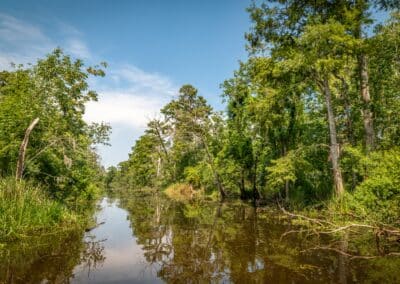
ESE conducted a comprehensive cultural resources survey for an approximately 11-mile linear energy infrastructure project crossing federally managed lands in East Texas, where portions of the alignment were subject to Section 106 review under the National Historic Preservation Act, requiring coordination with federal agencies and adherence to Secretary of the Interior standards. The multi-segment corridor traversed dense pine forest, creek crossings, and areas of limited ground surface visibility — and with previously recorded archaeological sites in the vicinity and both open trenching and directional boring planned, the survey had to withstand rigorous agency review while maintaining schedule certainty for a time-sensitive project. ESE executed a field strategy exceeding Texas Minimum Survey Standards, combining detailed archival research, 100 percent pedestrian survey coverage, 102 systematic shovel tests, and delineation of a previously recorded historic site — ultimately finding no prehistoric or historic archaeological components within the right-of-way and recommending the project proceed as planned with no additional cultural resources investigations required.
Mechanically Augmented Cultural Resources Survey for Mixed-Use Development
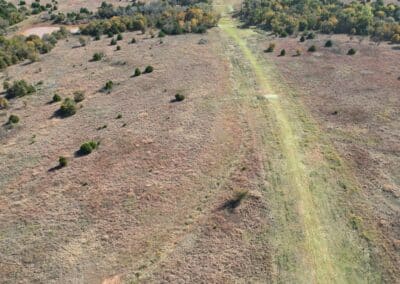
ESE conducted an intensive mechanically augmented cultural resources survey and limited testing program for a 468-acre tract planned for mixed-use development including residential, commercial, and utility infrastructure, with the objective of identifying significant cultural resources and providing clear recommendations that would allow development to proceed in compliance with applicable preservation standards. The tract presented varied archaeological sensitivity across ranch land, creek corridors, and areas of deep alluvial soils — and early fieldwork identified a previously unknown prehistoric site and a deeply buried aboriginal burial, requiring immediate coordination, specialized bioarchaeological expertise, and careful evaluation to balance preservation obligations with project delivery. ESE designed a phased investigation integrating mechanical trenching, auger and shovel testing, Ground Penetrating Radar, and magnetometer surveys to evaluate site integrity and delineate boundaries — ultimately documenting six previously unrecorded cultural resource sites, confirming the burial's eligibility for the National Register of Historic Places, and providing defensible avoidance strategies that allowed development planning to move forward while preserving significant cultural resources.
National Register Testing for Historic Railway Station Site
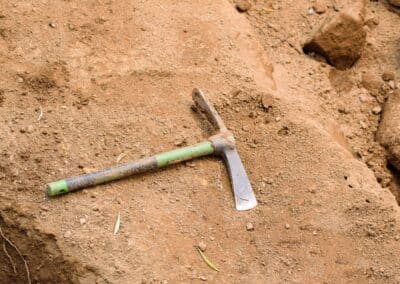
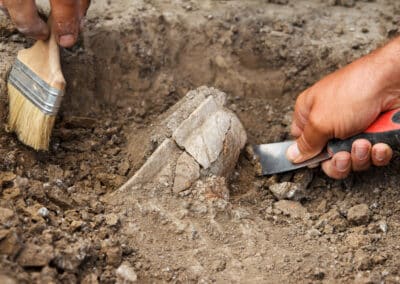
ESE conducted intensive mechanically augmented National Register of Historic Places testing for a 7.4-acre historic railway station site in Texas in advance of planned public infrastructure improvements, with the objective of determining eligibility, evaluating intact cultural deposits, and providing a clear recommendation regarding project impacts. The site had been previously identified as containing significant historic deposits associated with early railway development, plantation-era activity, and later institutional land use — requiring a methodical approach to distinguish meaningful cultural deposits from later disturbances while maintaining schedule certainty for a publicly funded capital improvement project. ESE designed a comprehensive testing program under Texas Antiquities Committee permit, conducting mechanically assisted excavation, controlled hand excavation, metal detecting, and anomaly verification across eight trenches, eight scrapes, fifteen anomaly tests, and three controlled units — ultimately confirming that significant cultural deposits were confined to areas outside the proposed construction footprint and that planned improvements would not adversely impact NRHP-eligible portions of the site.
Cultural Resources Survey Broadband Infrastructure Project
ESE Partners provided Cultural Resources Services for the western segment of a ~319-mile fiber communications line spanning from Patricia to El Paso, Texas. The project required coordination across multiple state and federal agencies—including TxDOT, USACE, NPS, THC, and NTIA—and was conducted under Texas Antiquities Committee Permit No. 31976. Following extensive fieldwork and compliance with NHPA, NEPA, and THC/CTA survey standards, ESE’s Phase I survey confirmed the project could move forward without adverse impacts to cultural resources, provided monitoring was maintained in sensitive areas. This effort not only exceeded regulatory requirements but also ensured the fiber line could proceed responsibly, preserving Texas’ cultural heritage while enabling critical infrastructure development.
Powerline Cultural Resources Survey
ESE Partners recently conducted an intensive mechanically augmented cultural resources survey of a proposed 18.7-Mile powerline, in Cameron County, Texas. Click here to learn more about this project!
Cultural Resources Survey
ESE Partners recently conducted intensive mechanically augmented cultural resources survey of the 1,310.35-Acre 560-Hectare tract in Waller County, Texas. The Client was proposing to construct a mixed use development under a Municipal Utility District. Prior to the designation of the district by the state legislature, ESE conducted a full Reconnaissance Survey and a 20-percent Cultural Resources Survey for the purposes of due diligence and cost analysis in March of 2022. This limited survey allowed ESE to identify disturbed areas which would be omitted from future survey effort.