In fast-growing Texas markets, redevelopment is often constrained by something invisible: legacy groundwater contamination from historical industrial or fuel releases. Even when every surrounding property is served by municipal water, sites can still be forced into years of monitoring or groundwater treatment to meet drinking-water standards that will never apply in practice.
This disconnect between real exposure and regulatory assumptions creates one of the biggest sources of uncertainty for developers, lenders, and attorneys working on urban properties.
Municipal Setting Designations were created to solve exactly this problem.
An MSD is a formal designation adopted by a city and certified by the Texas Commission on Environmental Quality that prohibits the use of groundwater for drinking within a defined area. Under Texas’ risk-based cleanup framework, that prohibition removes the groundwater ingestion pathway from the regulatory equation. Instead of trying to make groundwater potable, project teams can focus on the exposure pathways that actually affect people — such as soil contact and vapor intrusion.
For redevelopment and transactions, the impact is significant.
By eliminating unnecessary groundwater cleanup obligations, MSDs often shorten closure timelines by months and reduce total remediation costs by 30 to 50 percent compared to traditional plume management approaches. They also provide lenders and legal teams with a clearer, more defensible regulatory framework, improving underwriting confidence and reducing transaction risk.
MSDs are now a proven part of the redevelopment landscape across Texas. Cities like Houston, Dallas, Fort Worth, San Antonio, and Katy actively use them to support infill development, adaptive reuse, and brownfield revitalization while still protecting public health. As more municipalities integrate MSDs into their planning and permitting processes, they are becoming an increasingly important tool for aligning environmental regulation with economic growth.
The real value of an MSD is not just cost savings — it is predictability.
When developers, owners, and lenders know early in a project that groundwater ingestion is no longer a pathway of concern, they can plan schedules, budgets, and financing with far greater confidence. That shift from uncertainty to clarity is often what turns a stalled site into a viable one.
For Texas projects dealing with residual groundwater impacts in urban settings, MSDs are not a workaround. They are a smart, risk-based planning tool that reflects how cities actually use water today.
If you’re evaluating a site where groundwater is driving the deal more than real exposure risk, it may be time to look at whether an MSD belongs in your strategy.
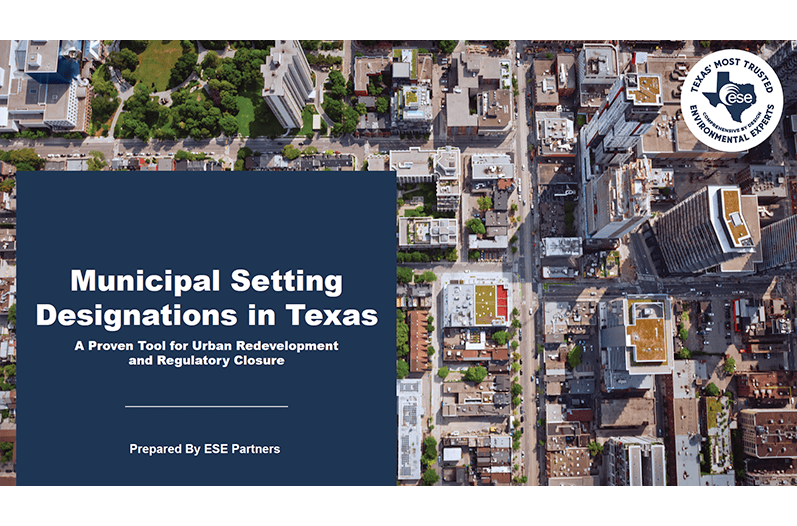
Download our full Texas Municipal Setting Designations white paper Here.