Preparing for the 2026 TPDES Multi-Sector General Permit, TXR050000
Executive Summary
Texas industrial facilities should treat the 2026 renewal of the TPDES Multi-Sector General Permit (MSGP), TXR050000, as more than a paperwork deadline. The permit renewal creates a natural checkpoint to confirm coverage status, validate SIC and NAICS classifications, update site maps and stormwater controls, refresh sampling programs, and correct gaps before the next five-year permit cycle begins.
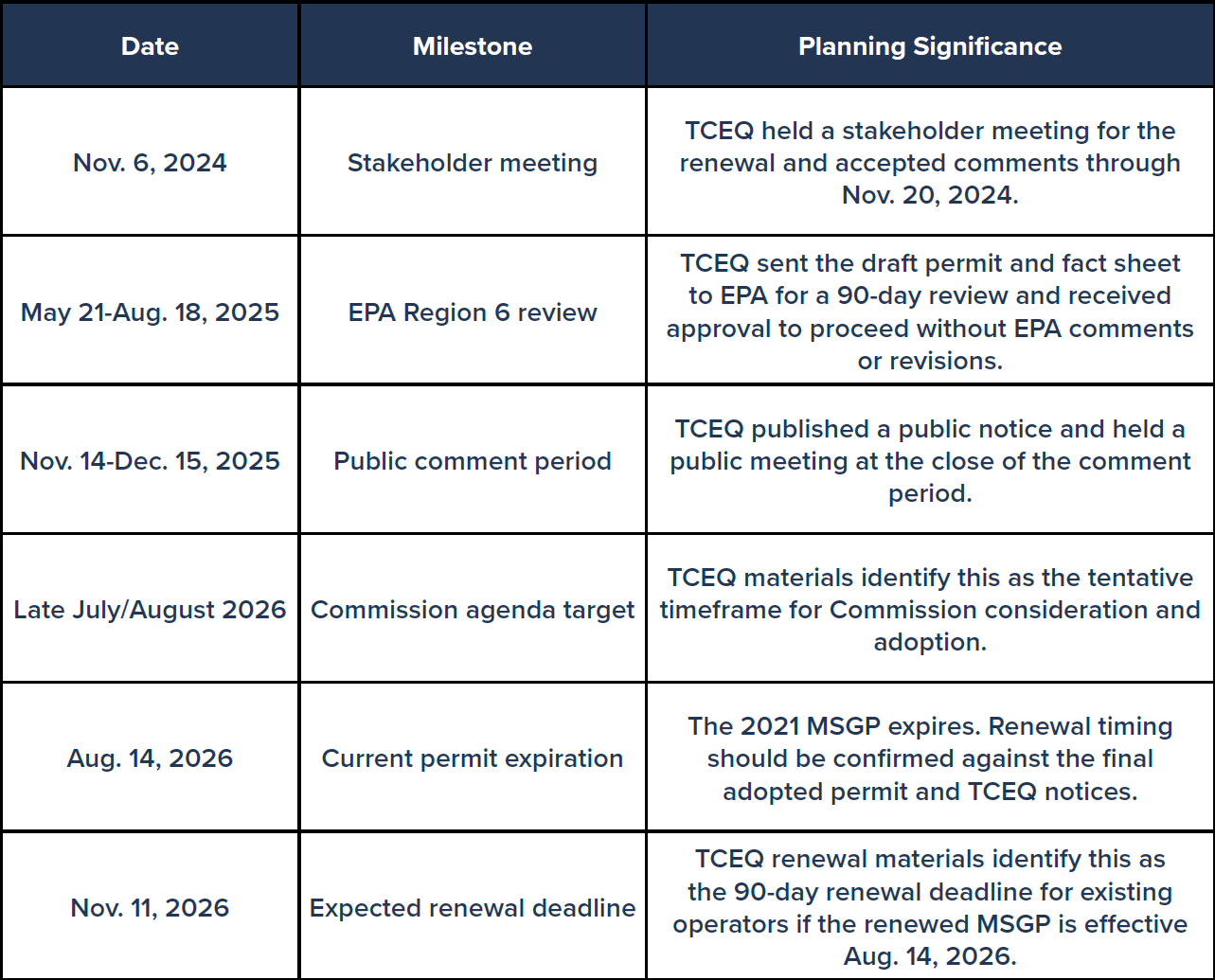
TCEQ states that the current MSGP expires on August 14, 2026, and that existing operators with active authorizations at expiration will have 90 days after adoption and the effective date of the 2026 MSGP to renew their applications. TCEQ currently lists November 11, 2026, as the renewal deadline, assuming the renewed permit takes effect on August 14, 2026, as expected.
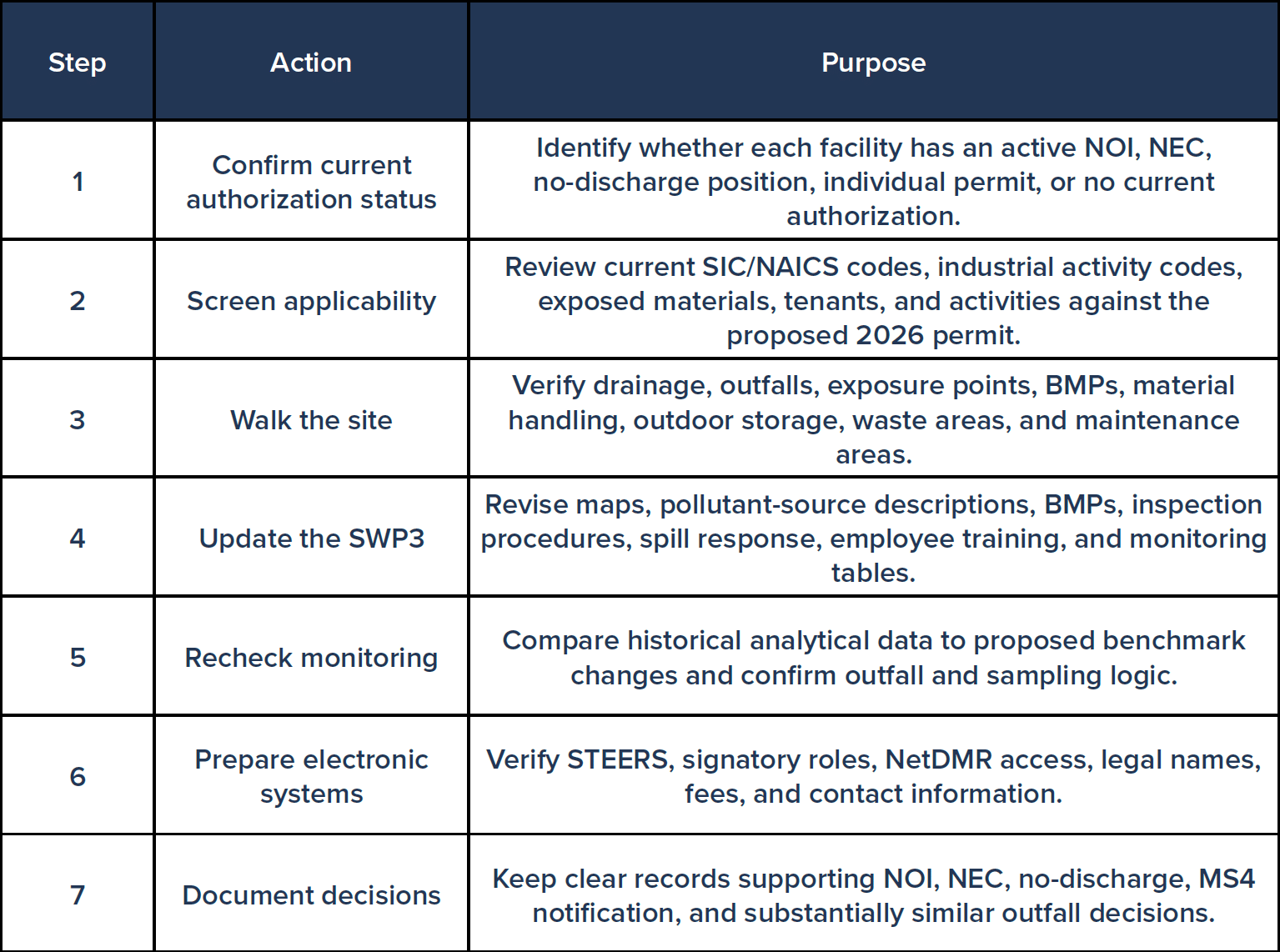
For ESE Partners’ clients and other Texas operators, the most practical approach is to use the period before the renewal window opens to complete an industrial stormwater readiness review. Facilities should confirm whether they need a Notice of Intent (NOI), may qualify for a No Exposure Certification (NEC), can support a no-discharge position, or need a different authorization. Regardless of the situation, ESE Partners is available to support.
Who May Need MSGP Coverage
The MSGP applies to point-source discharges of stormwater associated with industrial activity and to certain non-stormwater discharges to surface water in the state. TCEQ describes the covered runoff as stormwater from manufacturing, processing, material storage, waste material disposal, and similar areas where stormwater can contact industrial pollutants.
A Texas facility may need coverage when stormwater associated with industrial activity is discharged to surface water in the state and the facility is within a covered standard industrial classification (SIC) code, is subject to federal categorical effluent limitations, or is otherwise designated by TCEQ as needing coverage.
Typical covered categories include manufacturing, mining and materials processing, chemical and allied products, concrete and aggregate-related operations, metal products, recycling, land transportation and warehousing, landfills and land application, steam electric power, wastewater treatment works, air transportation, water transportation, and other listed sectors.
Facilities with no exposed industrial materials or activities may be able to use a NEC, but the facility must be able to show that industrial materials and activities are isolated from rain, snow, snowmelt, and runoff by storm-resistant shelter or otherwise meet the specific no-exposure conditions.
Facilities with all stormwater retained on-site may be able to support a no-discharge position, but that conclusion should be documented carefully because it is site-specific and may depend on drainage, overflow conditions, topography, and operating practices.
Recent & Upcoming Regulatory Dates
Notable Proposed Changes From the 2021 MSGP
The renewal does not appear to rewrite the MSGP from the ground up, but several proposed changes matter operationally. The most important theme is that facilities should not assume the renewal can be handled by simply copying prior application data. Classifications, outfalls, monitoring obligations, MS4 notifications, and benchmark assumptions all deserve a fresh look.
SIC/NAICS Organization and Updates: TCEQ proposes moving SIC/NAICS tables from Part II to Appendix A, updating 2017 NAICS references to reflect 2022 NAICS changes, and removing SIC 1231 for anthracite mining from Sector H and related tables. Operators should verify current operations against the renewed classification tables before filing a renewal NOI or NEC.
Electronic SWP3 Option: TCEQ proposes allowing facilities to prepare and maintain an electronic SWP3, consistent with the construction general permit approach. Digital SWP3 systems should still be inspection-ready, controlled, current, and accessible to responsible personnel.
MS4 Notification Clarification: Applications must be submitted to any MS4 receiving discharges, regardless of whether that MS4 is regulated by TCEQ. Facilities should confirm actual receiving drainage and identify all MS4 operators before renewal.
Substantially Similar Outfalls: TCEQ proposes clarifying that substantially similar outfalls may not be established for water-quality monitoring requirements under Part III.B.4. Sampling plans should be rechecked, so water-quality monitoring obligations are not improperly represented by another outfall.
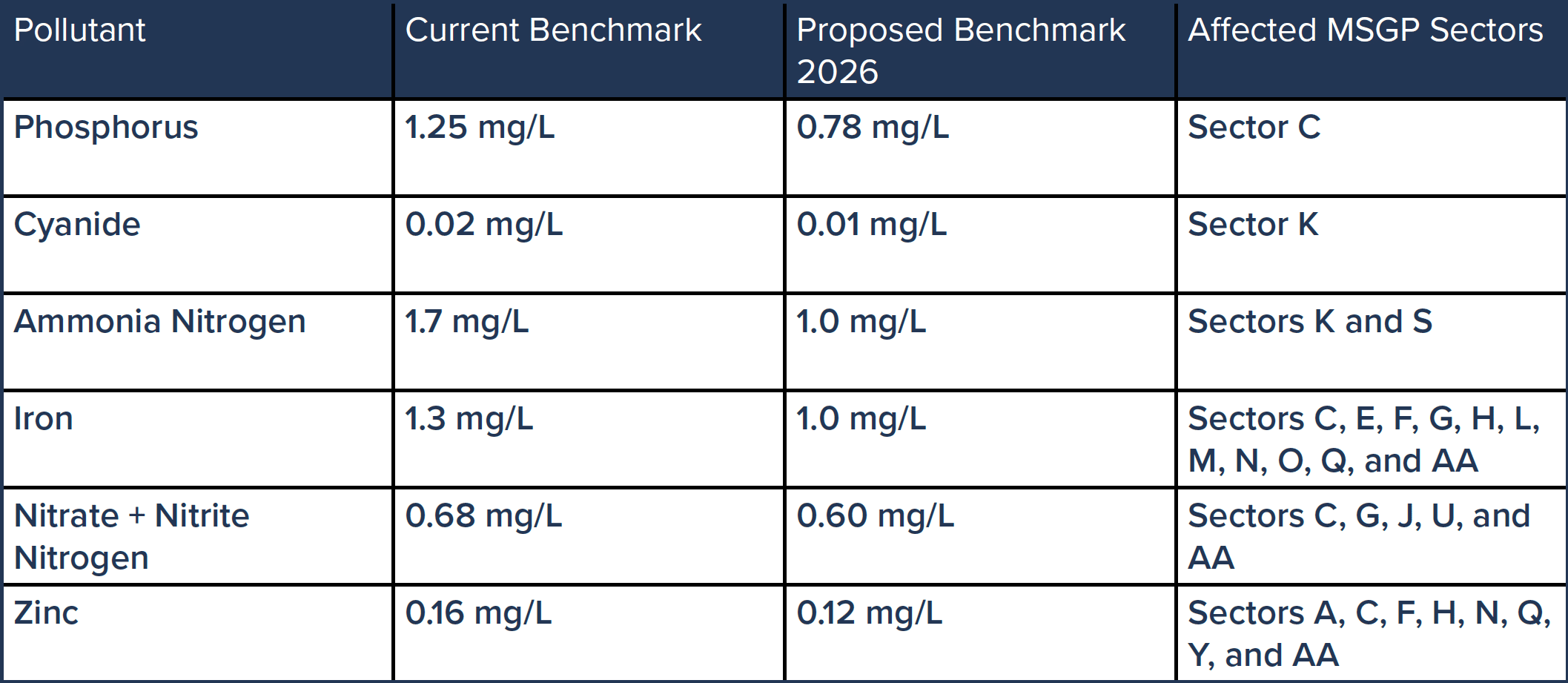
Benchmark Value Reductions: TCEQ proposes lowering selected benchmark values for phosphorus, cyanide, ammonia nitrogen, iron, nitrate plus nitrite nitrogen, and zinc for specific sectors. Facilities with historical results near prior benchmarks should evaluate BMP effectiveness and sampling trends before the first monitoring period under the renewed permit.
High-Level Radioactive Waste Prohibition: The draft adds a definition and prohibition for stormwater discharges associated with facilities licensed by the USNRC under 10 CFR Part 72 for storage or disposal of high-level radioactive waste. Most operators will simply need to answer the revised application confirmation, but it is a new eligibility representation.
NOI and NOC Updates: Proposed changes include collecting latitude and longitude and clarifying certain NOC changes, such as legal-name changes and permitted-site-name changes. Renewal records should match the legal operator, physical site, site map, and STEERS account structure.
Benchmark Monitoring Changes
Larger Compliance Needs During the Renewal Cycle
1. Applicability and Coverage Strategy
The first question is not ‘How do we renew?’ but ‘What authorization is correct for this facility as it operates today?’ Operators should evaluate current processes, tenants, outdoor storage, drainage changes, SIC/NAICS classifications, stormwater exposure, receiving waters, MS4 connections, and whether the facility’s prior authorization still aligns with the physical and operational realities on the ground.
A facility that previously held an NEC may no longer qualify if outdoor storage, leaking containers, exposed material handling, waste accumulation, vehicle maintenance, or uncovered loading areas have changed. Conversely, a facility that historically held an NOI may be able to reduce burden if all industrial materials and activities are now protected from exposure and the no-exposure record can be supported.
2. SWP3 Review and Implementation
The SWP3 should be a living operating document, not a binder that appears only during inspections. Under the MSGP framework, the SWP3 should identify the stormwater pollution prevention team, describe potential pollutant sources, map drainage and outfalls, identify control measures and BMPs, address spills and good housekeeping, and document inspections, corrective actions, and monitoring requirements.
- Confirm that drainage maps show current outfalls, drainage directions, structural controls, material storage areas, industrial activity areas, and receiving waters or MS4 connections.
- Review whether BMPs are appropriate for current site conditions, including housekeeping, covered storage, secondary containment, sediment controls, material handling, waste management, spill response, and employee training.
- Make the SWP3 inspection-ready, whether maintained electronically or in hard copy. Electronic plans should be easy to access during a site visit and backed by controlled records.
3. Monitoring, Sampling and Reporting
Monitoring obligations vary by sector and by the specific pollutants associated with industrial activity. TCEQ’s benchmark-monitoring guidance states that benchmark monitoring analysis results are due by March 31 each year and that analytical results for effluent limitations and benchmark monitoring must be submitted electronically through NetDMR.
Facilities should use the renewal cycle to verify that required sampling points are correct, that qualifying storm-event procedures are understood, that sample collection and laboratory coordination are feasible, and that benchmark exceedance procedures are documented. The proposed benchmark reductions make this especially important for facilities with historical results close to prior benchmark values.
4. Records, Fees and Electronic Systems
TCEQ requires electronic submittal of MSGP NOI, NEC, NOT, and NOC forms through STEERS unless the applicant qualifies for an electronic reporting waiver. Facilities should confirm that the correct personnel have STEERS access, signatory authority, and delegated authority before the renewal window opens. Waiting until late in the renewal period creates avoidable risk if account permissions, legal names, or signer roles are wrong.
Operators should also check the annual fee status, the permittee’s legal names, facility addresses, site contact information, latitude and longitude, prior correspondence, NetDMR access, and any open compliance issues. Delinquent fees, inaccurate operator information, or unsigned applications can turn a routine renewal into a preventable scramble.
5. MS4, Receiving Water, Impairment, and TMDL Review
Stormwater compliance does not end at the facility fence line. Operators should identify whether the discharge enters an MS4, a ditch, a named water body, a water-quality segment, an impaired water body, or a watershed with TMDL requirements. The proposed MS4 notification clarification is a reminder that downstream receiving systems should be verified rather than assumed.
Recommended Readiness Actions Before Renewal
How ESE Partners Can Support Texas Operators
ESE Partners supports Texas industrial facilities by translating MSGP requirements into practical site actions. The renewal cycle is an opportunity to correct weak spots before they become enforcement issues, sampling surprises, or renewal bottlenecks.
- MSGP applicability reviews and coverage strategy for NOI, NEC, no-discharge, or alternative authorization decisions.
- Facility stormwater audits, drainage and outfall reviews, BMP evaluations, and corrective-action planning.
- SWP3 preparation, updates, electronic SWP3 organization, and site-map revisions.
- STEERS renewal support, NOI/NEC/NOC/NOT preparation, MS4 notification support, and operator-change coordination.
- Benchmark monitoring planning, sampling coordination, analytical-data review, NetDMR support, and benchmark exceedance response.
- Employee training, inspection forms, compliance calendars, and practical operating procedures tailored to Texas facilities.
Conclusion
The 2026 MSGP renewal is not just an administrative deadline. It is a practical checkpoint for industrial facilities to confirm coverage, update documentation, tighten BMPs, verify monitoring requirements, and ensure regulatory records reflect real site conditions.
Facilities that act early will be better positioned to renew coverage on time, avoid preventable application delays, and enter the next permit cycle with a cleaner compliance baseline. ESE Partners is prepared to help Texas operators assess applicability, update SWP3s, navigate STEERS and NetDMR requirements, evaluate sampling obligations, and build a practical path to continued MSGP compliance.
Note: This white paper is intended for planning and general informational purposes. Operators should confirm final requirements against the adopted 2026 MSGP, TCEQ renewal notices, and facility-specific conditions.