Data center development is experiencing rapid expansion across Texas and across the broader United States. As demand for cloud computing, artificial intelligence infrastructure, and high-performance data processing continues to increase, developers are moving quickly to identify and secure viable sites for large-scale facilities.
Texas has emerged as a major hub for this growth due to its available land, energy infrastructure, and business environment. However, as development accelerates, environmental planning is becoming a key determinant of how efficiently projects can move from concept to construction.
Speed remains important, but it is no longer the only factor. Regulatory clarity, site-specific environmental understanding, and early identification of constraints are increasingly shaping project outcomes.
Environmental Strategy Is Now a Core Part of Site Selection
For data center developers, site selection is no longer just a matter of power availability and land access. Environmental conditions can significantly influence whether a project moves forward on schedule or encounters delays during permitting.
Early environmental strategy helps identify constraints before major investments are made in design or interconnection planning. This includes understanding whether a site may trigger additional regulatory review or require mitigation measures that affect cost or schedule.
As a result, environmental due diligence is now being integrated much earlier in the development process than in previous cycles of infrastructure growth.
Key Environmental Components Influencing Development
A wide range of environmental studies and permitting considerations can impact data center project timelines. These often include:
- Phase I Environmental Site Assessments (ESAs) to evaluate historical and current site conditions
- Wetland delineations and jurisdictional determinations under the Clean Water Act
- Biological resource studies to assess habitat and protected species
- Cultural resource investigations under NEPA-related requirements
- Air permitting evaluations for backup generation and operational impacts
- Water resources coordination for supply, discharge, and utility connections
- NEPA planning and documentation where applicable
- Permit matrices to track overlapping regulatory requirements across agencies
Individually, each of these components provides critical insight into site feasibility. Together, they help define the overall regulatory pathway for a project.
Early Identification of Constraints Reduces Downstream Risk
One of the most important advantages of early environmental planning is the ability to identify constraints before they affect engineering or construction schedules.
Wetlands, cultural resources, endangered species habitat, or air permitting thresholds can all introduce additional review requirements if not identified early in development. When these issues are discovered later in the process, they often require redesign, supplemental studies, or extended agency coordination.
By addressing these considerations early, developers can reduce uncertainty and maintain more predictable project timelines.
Growth Requires More Than Speed
As digital infrastructure demand continues to grow, successful data center development is increasingly defined by more than just speed to market.
Projects that move efficiently are those that combine rapid development goals with a clear understanding of regulatory requirements and environmental conditions. This balance allows teams to anticipate challenges rather than react to them during later stages of development.
Regulatory clarity and environmental insight are becoming just as important as site capacity and interconnection feasibility.
Supporting Critical Infrastructure Development
Over the past year, ESE Partners has supported more than 40 proposed and operating data center facilities across Texas and beyond, representing several gigawatts of power capacity.
This work has included environmental site assessments, permitting support, regulatory coordination, and pre-construction planning across a wide range of project types and locations.
As infrastructure demand continues to expand, environmental consulting plays an increasingly important role in helping ensure that projects are both viable and responsibly developed.
ESE is proud to support the advancement of critical digital infrastructure while helping protect communities and natural resources.
Moving Forward With Clarity
Data center development will continue to shape Texas’ infrastructure landscape in the years ahead. As it does, environmental planning will remain a key factor in determining which projects move forward efficiently and which encounter avoidable delays.
At ESE Partners, we help developers, utilities, and infrastructure teams identify environmental constraints early, navigate permitting requirements, and develop clear paths to compliance so projects can move forward with confidence and clarity.
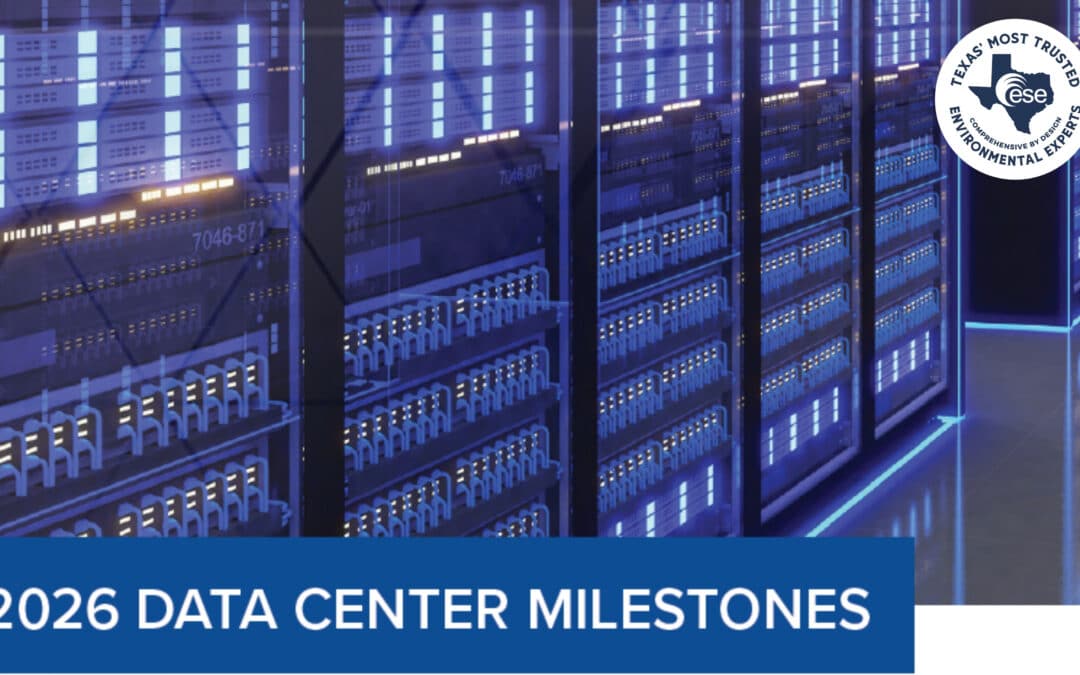
View our 2026 Data Center Milestones here: https://lnkd.in/gWqQGSC9