Why Early Environmental Due Diligence Matters
Environmental constraints are often easier and less expensive to address when they are identified during site selection rather than after a property has been acquired or a project has been designed.
Early environmental due diligence provides an opportunity to understand the conditions that could affect a property before major development decisions are made. This information can help project teams evaluate whether a site is appropriate for the proposed development, determine whether additional investigation is necessary, and identify potential permitting or mitigation requirements.
For data center projects operating under tight schedules, this early understanding can be particularly valuable. Discovering an environmental constraint after significant capital has been committed can leave a project team with fewer options and less flexibility to adjust the project.
Environmental Considerations During Site Selection
A comprehensive evaluation of a potential data center site should consider a range of environmental conditions. Some may be readily apparent, while others require more detailed investigation.
Historical land use, for example, can reveal potential environmental concerns that are not obvious from a current property inspection. A Phase I Environmental Site Assessment (ESA) may identify historical industrial operations, petroleum-related activities, agricultural chemical use, rail corridors, disposal areas, or other conditions that warrant additional investigation.
Where potential concerns are identified, a Phase II ESA may be appropriate to further evaluate environmental conditions and determine whether contamination is present.
Natural resources can present another significant consideration. Wetlands, jurisdictional waters, floodplains, protected species habitat, and other sensitive resources may affect the location and configuration of proposed facilities. These constraints can influence site layout, permitting requirements, mitigation obligations, and the overall development schedule.
Cultural resources should also be considered during the planning process. Depending on the location and nature of a proposed project, cultural resource considerations may affect development activities and regulatory requirements.
Air Quality and Backup Generation
Air quality permitting can become an important consideration for data center development, particularly because data centers commonly rely on backup generators to maintain operations during power disruptions.
The number and size of generators associated with a facility can create significant permitting considerations. Depending on the proposed equipment, operating scenarios, and applicable regulatory requirements, potential emissions may affect the type of authorization required and the overall project schedule.
Evaluating air quality requirements early allows project teams to better understand potential permitting obligations before equipment selections and facility designs are finalized.
Water Availability and Long-Term Operations
Water availability is another consideration that can influence both site selection and long-term data center operations.
Large-scale data centers may have substantial water requirements depending on the facility’s cooling technology and operational design. As communities and regulators place increasing attention on water resources, understanding the availability and sustainability of water supplies can become an important part of evaluating a potential site.
Water considerations should therefore extend beyond whether adequate supply is available for initial development. Project teams should also consider how water availability may affect long-term operations and the broader community in which a facility is located.
Utility and Transmission Infrastructure
Power availability is one of the most important factors in data center site selection, but having access to electrical infrastructure does not necessarily mean that a site can immediately support the proposed development.
Utility and transmission infrastructure may require additional evaluation as part of the development process. The location and capacity of transmission lines, substations, and other infrastructure can influence site planning, permitting, construction requirements, and project timelines.
Understanding these considerations early can help developers evaluate whether the site’s existing infrastructure is consistent with the project’s anticipated energy requirements and development schedule.
Climate Resilience and Long-Term Risk
Data centers are mission-critical facilities expected to operate for decades. As a result, environmental due diligence should consider not only immediate permitting and development requirements but also conditions that could affect long-term resilience.
Flood exposure, extreme heat, severe weather, wildfire risk, and other environmental hazards can create operational challenges over the life of a facility. Evaluating these risks during site selection can help project teams make more informed decisions about location, facility design, infrastructure, and resilience measures.
Considering long-term environmental conditions alongside near-term development requirements can provide a more complete understanding of a site’s overall risk profile.
Environmental Due Diligence as a Planning Tool
Environmental due diligence should not be viewed simply as a regulatory checkbox or an additional step that slows development.
For data center projects, it can serve as a strategic planning tool that helps identify potential obstacles while there is still time to address them.
When environmental conditions are evaluated early, project teams may have greater flexibility to modify site layouts, investigate alternatives, plan for mitigation, evaluate permitting requirements, or reconsider a site before significant capital has been committed.
That flexibility becomes increasingly valuable as data center projects become larger, more complex, and more time-sensitive.
Building Environmental Considerations Into the Development Process
Data center development requires coordination across numerous disciplines, and environmental considerations should be incorporated into that process from the beginning.
Developers, investors, lenders, and operators evaluating potential sites should consider environmental due diligence alongside power, fiber, land, transportation, and other critical development factors. By evaluating these considerations together, project teams can develop a more complete understanding of a site’s opportunities and constraints.
The objective is not to eliminate every potential environmental issue. Rather, it is to identify those issues early enough to make informed decisions about how they can be addressed.
For data center projects operating under compressed timelines, the timing of environmental due diligence can be just as important as the due diligence itself. Identifying a constraint before a property is acquired or a project is designed provides significantly more opportunity to respond than discovering the same constraint after development is already underway.
Learn More
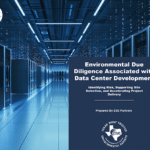
ESE Partners’ white paper, Environmental Due Diligence Associated with Data Center Development, examines the environmental considerations that should be evaluated during the early stages of data center development, including Phase I and Phase II ESAs, natural resources, air quality permitting, water availability, utility and transmission infrastructure, and climate resilience.